SAR ADC
Simulation of a Successive Approximation Register ADC with custom block creation.
You can also find this example as a single file in the GitHub repository.

Successive Approximation Register (SAR) ADC Principle
A SAR ADC converts analog signals to digital using a binary search algorithm:
- Sample the input voltage
- Test the MSB (Most Significant Bit) by comparing to DAC output
- Keep the bit if comparison succeeds, discard if it fails
- Repeat for each bit from MSB to LSB
- Output the complete digital word
This requires N comparisons for N bits, making it efficient for medium-speed, medium-resolution applications (10-18 bits, up to several MHz).
Custom SAR Logic Block
We'll implement the SAR control logic as a custom block using PathSim's event system.
This example shows how to create custom blocks by extending the Block class and using Schedule events for discrete-time logic.
Creating a Custom SAR Logic Block
This is one of PathSim's powerful features - you can create custom blocks with complex behavior. The SAR block:
- Uses scheduled events to step through bits
- Implements the binary search algorithm
- Outputs N parallel digital signals (one per bit)
System Parameters
We'll use:
- 8-bit resolution
- 50 Hz sampling frequency
- Modulated sine wave as input signal
Block Diagram Setup
The system consists of:
- src: Modulated sine wave source
- sah: Sample & Hold to freeze input during conversion
- sub: Subtractor (input - DAC)
- cpt: Comparator
- sar: Custom SAR logic
- dac1: Fast DAC for comparison (updates every bit)
- dac2: Output DAC (updates every sample)
- lpf: Lowpass filter for reconstruction
Connections
The connections form the SAR ADC loop. Notice how the 8 digital bits from SAR connect to both DACs in parallel.
Simulation
We run the simulation with an adaptive solver that can handle the discrete-time events efficiently.
12:44:01 - INFO - LOGGING (log: True)
12:44:01 - INFO - BLOCKS (total: 9, dynamic: 1, static: 8, eventful: 5)
12:44:01 - INFO - GRAPH (nodes: 9, edges: 27, alg. depth: 3, loop depth: 0, runtime: 0.141ms)
12:44:01 - INFO - STARTING -> TRANSIENT (Duration: 1.00s)
12:44:01 - INFO - --------------------   1% | 0.0s<0.7s | 1713.6 it/s
12:44:01 - INFO - ####----------------  20% | 0.2s<1.2s | 1890.2 it/s
12:44:02 - INFO - ########------------  40% | 0.4s<0.4s | 1948.4 it/s
12:44:02 - INFO - ############--------  60% | 0.7s<0.5s | 1618.6 it/s
12:44:02 - INFO - ################----  80% | 0.9s<0.1s | 2590.3 it/s
12:44:02 - INFO - #################### 100% | 1.0s<--:-- | 2850.0 it/s
12:44:02 - INFO - FINISHED -> TRANSIENT (total steps: 2124, successful: 2034, runtime: 1046.22 ms)
Results
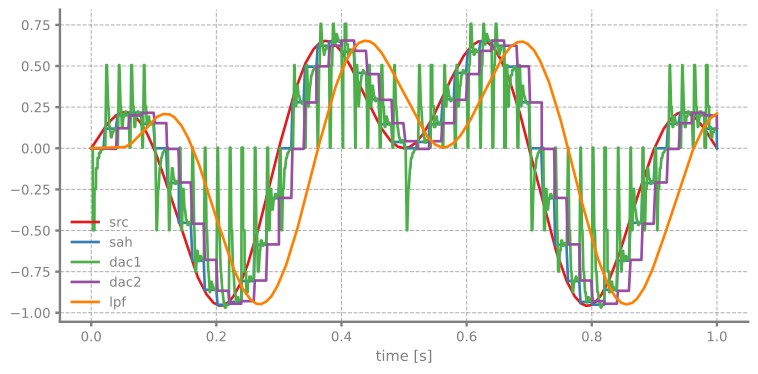
The plots show:
- src: Original analog input
- sah: Sampled and held signal
- dac1: Fast DAC during conversion (shows binary search)
- dac2: Output DAC (quantized signal)
- lpf: Reconstructed signal after filtering
Notice how dac1 shows the successive approximation steps within each sample period!