Bouncing Pendulum
This example demonstrates a hybrid system combining continuous pendulum dynamics with discrete bounce events. The pendulum swings until it hits the ground (zero angle), at which point it bounces back with reduced energy.
You can also find this example as a single file in the GitHub repository.
This example showcases:
- Nonlinear pendulum dynamics with ZeroCrossing event detection - State transformations at discrete events (angular velocity reversal) - Automatic differentiation through hybrid systems with the Value class - Sensitivity analysis of the bounce elasticity parameter
First let's import the Simulation and Connection classes along with the required blocks and event manager:
System Dynamics
The mathematical pendulum is governed by the nonlinear differential equation:
MATHDISPLAY0ENDMATH
where:
- MATHINLINE1ENDMATH is the angle from vertical
- MATHINLINE2ENDMATH is gravitational acceleration
- MATHINLINE3ENDMATH is the pendulum length
The bounce event occurs when MATHINLINE4ENDMATH (pendulum hits the ground), at which point the angular velocity reverses with a loss factor.
Note that we wrap the bounceback coefficient b in a Value instance to enable automatic differentiation. This allows us to compute sensitivities of the system response with respect to this parameter.
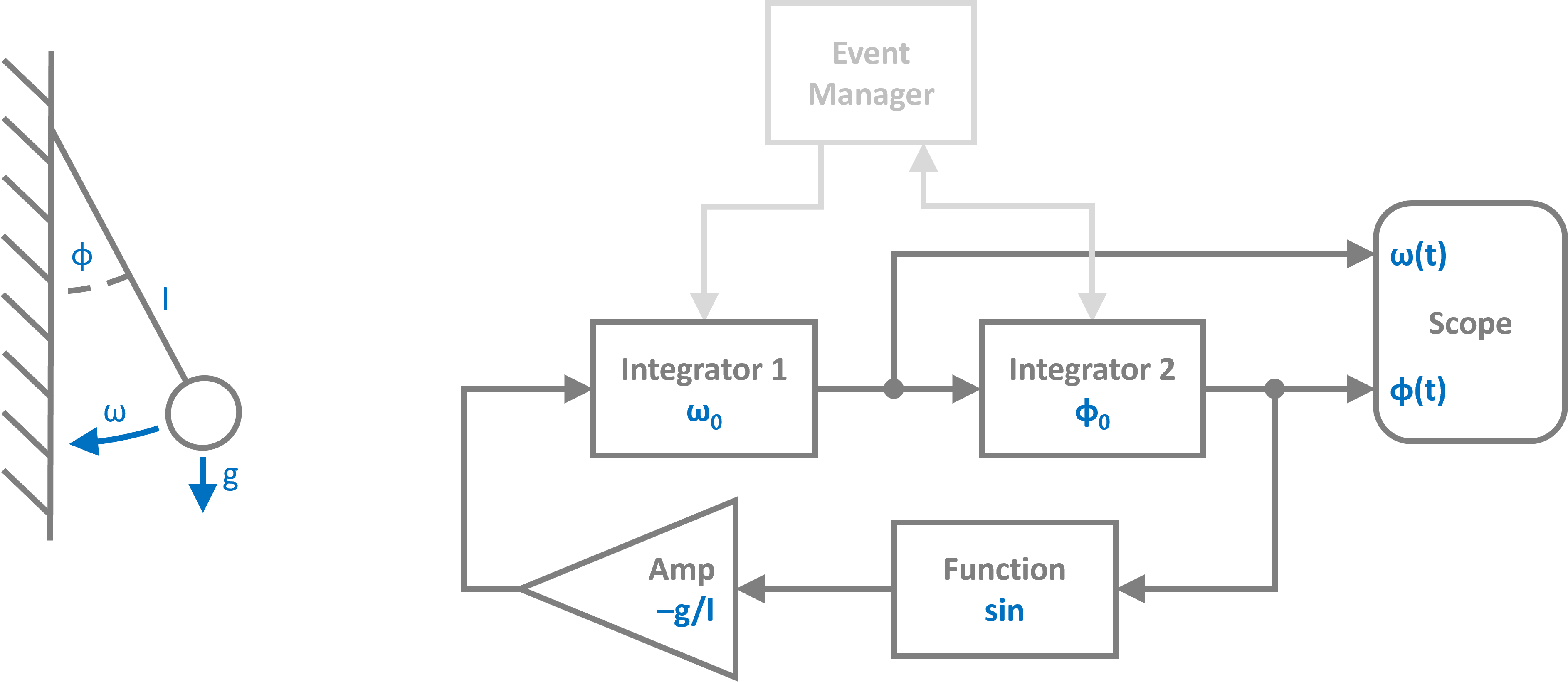
Block Diagram Construction
We construct the system from basic blocks:
Event Detection and Action
We define a ZeroCrossing event to detect when the pendulum hits the ground ($\phi = 0$). The event function monitors the angle, and the action function reverses the angular velocity with an energy loss factor.
The engine.set() method allows direct manipulation of block states during event actions. This is crucial for implementing the discontinuous velocity change at the bounce.
We initialize the simulation with the RKCK54 solver for accurate integration of the nonlinear dynamics:
12:43:20 - INFO - LOGGING (log: True)
12:43:21 - INFO - BLOCKS (total: 5, dynamic: 2, static: 3, eventful: 0)
12:43:21 - INFO - GRAPH (nodes: 5, edges: 6, alg. depth: 3, loop depth: 0, runtime: 0.070ms)
Now let's run the simulation:
12:43:21 - INFO - STARTING -> TRANSIENT (Duration: 15.00s)
12:43:21 - INFO - --------------------   1% | 0.0s<0.2s | 1176.4 it/s
12:43:21 - INFO - ####----------------  20% | 0.0s<0.1s | 2118.0 it/s
12:43:21 - INFO - ########------------  40% | 0.1s<0.1s | 2220.5 it/s
12:43:21 - INFO - ############--------  60% | 0.1s<0.0s | 2285.1 it/s
12:43:21 - INFO - ################----  80% | 0.1s<0.0s | 2227.5 it/s
12:43:21 - INFO - #################### 100% | 0.2s<--:-- | 2178.3 it/s
12:43:21 - INFO - FINISHED -> TRANSIENT (total steps: 327, successful: 254, runtime: 164.45 ms)
Results
Let's plot the angular velocity and angle over time, marking the bounce events:
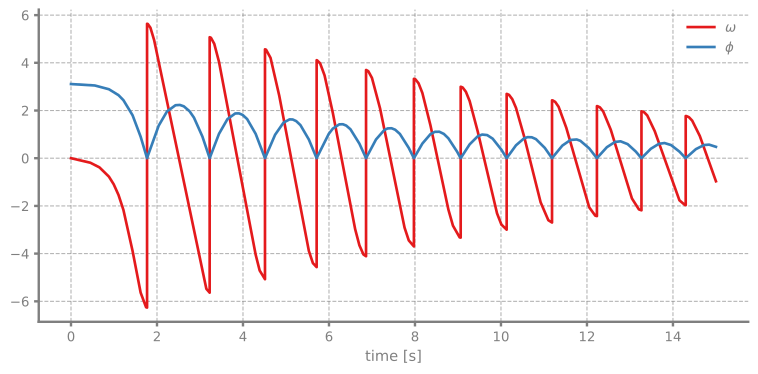
The plot shows:
- The angle oscillates between 0 and some maximum value that decreases over time
- The angular velocity reverses sign at each bounce (vertical dashed lines)
- Energy is progressively lost with each bounce, leading to smaller oscillations