Reactor Point Kinetics
Simulating the transient neutron population in a nuclear reactor using the point kinetics equations (PKE) with six delayed neutron precursor groups.
The point kinetics model couples the neutron density MATHINLINE2ENDMATH with MATHINLINE3ENDMATH delayed neutron precursor groups MATHINLINE4ENDMATH:
MATHDISPLAY0ENDMATH
MATHDISPLAY1ENDMATH
where MATHINLINE5ENDMATH is the total delayed neutron fraction, MATHINLINE6ENDMATH is the prompt neutron generation time, and MATHINLINE7ENDMATH is the reactivity.
The point kinetics system is very stiff — the prompt neutron generation time MATHINLINE0ENDMATH creates eigenvalues on the order of MATHINLINE1ENDMATH. The variable-order BDF solver GEAR52A is ideal here: it requires only one implicit solve per step and adapts both step size and order to the smooth exponential dynamics. The default fixed-point tolerance (1e-9) is unnecessarily tight for this problem; relaxing it to 1e-6 gives a ~70x speedup with negligible loss in accuracy.
1. Delayed Supercritical Step
Insert a step reactivity of MATHINLINE2ENDMATH (about MATHINLINE3ENDMATH). Since MATHINLINE4ENDMATH, the reactor is delayed supercritical — the power rises on a slow time scale governed by the delayed neutrons.
10:55:03 - INFO - LOGGING (log: True)
10:55:03 - INFO - BLOCKS (total: 4, dynamic: 1, static: 3, eventful: 0)
10:55:03 - INFO - GRAPH (nodes: 4, edges: 3, alg. depth: 1, loop depth: 0, runtime: 0.162ms)
10:55:03 - INFO - STARTING -> TRANSIENT (Duration: 100.00s)
10:55:03 - INFO - --------------------   1% | 0.1s<0.9s | 911.2 it/s
10:55:03 - INFO - ####----------------  21% | 0.2s<0.1s | 830.1 it/s
10:55:03 - INFO - ########------------  41% | 0.2s<0.0s | 925.1 it/s
10:55:03 - INFO - ############--------  61% | 0.2s<0.0s | 895.4 it/s
10:55:03 - INFO - ################----  81% | 0.2s<0.0s | 935.6 it/s
10:55:03 - INFO - #################### 100% | 0.2s<--:-- | 932.0 it/s
10:55:03 - INFO - FINISHED -> TRANSIENT (total steps: 127, successful: 114, runtime: 222.29 ms)
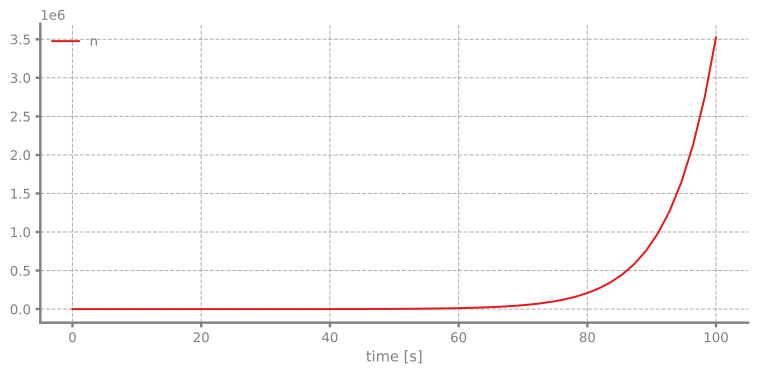
The neutron density rises exponentially on a time scale of seconds — much slower than the prompt neutron lifetime (MATHINLINE0ENDMATH s) because the delayed neutrons control the dynamics when MATHINLINE1ENDMATH.
2. Prompt Supercritical
Insert MATHINLINE0ENDMATH. Now the reactor is prompt supercritical — the power rises on the prompt neutron time scale, producing a rapid excursion.
10:55:04 - INFO - LOGGING (log: True)
10:55:04 - INFO - BLOCKS (total: 4, dynamic: 1, static: 3, eventful: 0)
10:55:04 - INFO - GRAPH (nodes: 4, edges: 3, alg. depth: 1, loop depth: 0, runtime: 0.152ms)
10:55:04 - INFO - STARTING -> TRANSIENT (Duration: 0.50s)
10:55:04 - INFO - --------------------   1% | 0.1s<0.7s | 797.0 it/s
10:55:04 - INFO - ####----------------  20% | 0.1s<0.3s | 798.6 it/s
10:55:04 - INFO - ########------------  40% | 0.2s<0.3s | 643.1 it/s
10:55:04 - INFO - ############--------  60% | 0.3s<0.1s | 1095.2 it/s
10:55:04 - INFO - ################----  80% | 0.4s<0.1s | 871.5 it/s
10:55:04 - INFO - #################### 100% | 0.4s<--:-- | 1132.2 it/s
10:55:04 - INFO - FINISHED -> TRANSIENT (total steps: 313, successful: 302, runtime: 428.91 ms)
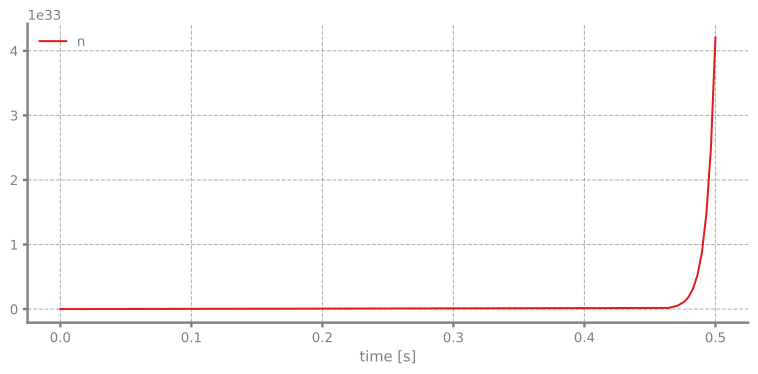
The power rises orders of magnitude within milliseconds. This is why prompt criticality must be avoided in reactor design — the delayed neutrons are the key safety mechanism that keeps power transients manageable.
3. Subcritical with External Source
A subcritical assembly (MATHINLINE1ENDMATH) with a constant external neutron source. The system reaches an equilibrium where the source multiplication produces a steady neutron population:
MATHDISPLAY0ENDMATH
10:55:04 - INFO - LOGGING (log: True)
10:55:04 - INFO - BLOCKS (total: 4, dynamic: 1, static: 3, eventful: 0)
10:55:04 - INFO - GRAPH (nodes: 4, edges: 3, alg. depth: 1, loop depth: 0, runtime: 0.157ms)
10:55:04 - INFO - STARTING -> TRANSIENT (Duration: 50.00s)
10:55:04 - INFO - --------------------   1% | 0.1s<0.6s | 1228.8 it/s
10:55:04 - INFO - ####----------------  20% | 0.1s<0.0s | 1265.3 it/s
10:55:04 - INFO - ########------------  42% | 0.1s<0.0s | 1014.2 it/s
10:55:04 - INFO - ############--------  64% | 0.1s<0.0s | 1095.2 it/s
10:55:04 - INFO - #################---  88% | 0.1s<0.0s | 1055.4 it/s
10:55:04 - INFO - #################### 100% | 0.1s<--:-- | 1015.4 it/s
10:55:04 - INFO - FINISHED -> TRANSIENT (total steps: 113, successful: 97, runtime: 114.44 ms)
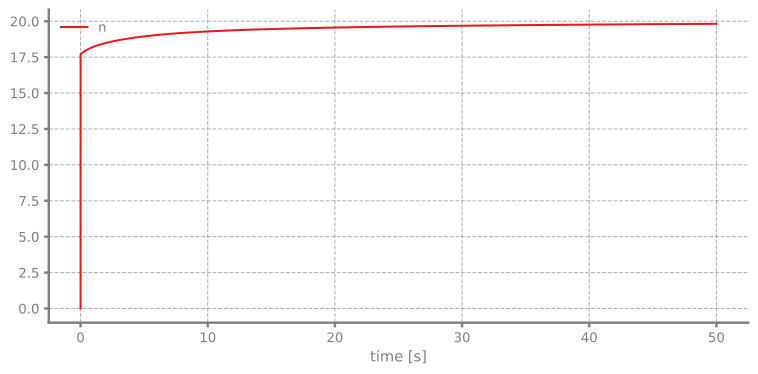
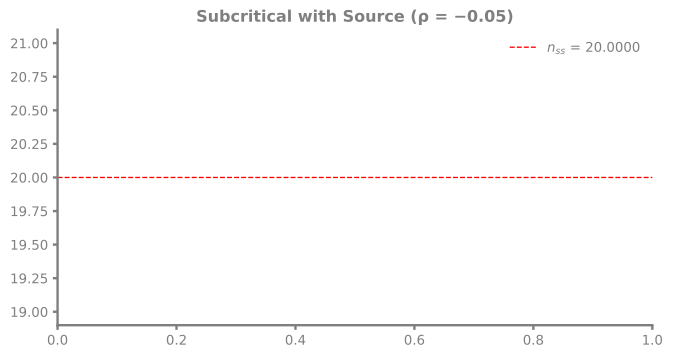
The neutron density converges to the expected source-multiplied equilibrium value, confirming the subcritical multiplication physics.